The 2026 Engagement Ring Shopping Guide
So you’ve decided to propose. Congratulations! Now comes the part nobody fully prepares you for: buying the ring.
Buying an engagement ring in 2026 is a wildly different experience than it was even five years ago. Lab-grown diamonds have flipped the market upside down. Online retailers have undercut traditional jewelers. Couples are increasingly shopping together, and doing it openly, without apology. The old rulebook is gone.
But that doesn’t make the decision any easier. If anything, having more options just means more chances to feel paralyzed or taken advantage of. This guide cuts through the noise so you can walk in (or click in) and approach the process with confidence.
What Should You Know Before You Even Walk Into a Jewelry Store?
The biggest mistake guys make is showing up at a jewelry store without any prep work. The second you walk through those doors, you’re operating on their turf, in their environment, with their salesperson steering the conversation. A little homework ahead of time changes everything.
Know her style. Not just her favorite color, but her actual jewelry preferences. Does she wear gold or silver? Delicate, minimal pieces or something bold and eye-catching? Does she post anything ring-adjacent on Pinterest or Instagram? Have her friends or family ever heard her mention what she’d want? You don’t have to be a spy, but casual observation goes a long way.
Know your budget range before anyone else does. Once you say a number out loud to a salesperson, everything they show you will be conveniently right at (or just over) that ceiling. Decide your range beforehand, and give yourself permission to say no to anything outside it.
Research online first. Sites like James Allen, Blue Nile, Brilliant Earth, and Whiteflash let you browse thousands of diamonds with complete grading info, 360° video, and real prices. This gives you a real-world sense of what things cost before anyone tries to upsell you.
Understand the terminology. You don’t need to become a gemologist, but knowing the basic vocabulary (see: the 4 Cs section below) means you’ll understand what you’re being told and ask better questions.
How Much Should You Actually Spend on an Engagement Ring?
Let’s kill the “two months’ salary” rule right now. That guideline was invented by De Beers in a 1980s marketing campaign. It is not a law. It is not a tradition. It was advertising.
According to The Knot’s 2024 Jewelry and Engagement Study, the national average for an engagement ring in the U.S. was around $5,200. Sixty-four percent of buyers spent under $6,000. A third spent under $3,000. The range is enormous, and there is no universally correct number.
What you spend should come down to three things:
1. What you can genuinely afford without financial strain
2. What she genuinely values in a ring
3. What makes sense given everything else you’re saving for
Some couples prioritize the ring above other expenses. Others would rather put that money toward a down payment or a honeymoon. Neither approach is wrong. What matters is that you’re making a deliberate choice rather than just defaulting to a number you once heard.
A few honest guidelines:
Spend what you can actually afford. Starting your engagement in credit card debt is not romantic.
Consider the total cost. The ring is just the start. You’ve got the wedding, the honeymoon, and the rest of your life ahead of you.
Factor in lab-grown options. A lab-grown diamond can give you a larger, higher-quality stone for significantly less money (more on this below). If she cares about size and sparkle more than origin, this completely changes your budget math.
Don’t let the jeweler set your expectations. They have a strong financial interest in you spending more.
And for perspective: a July 2025 survey of 1,000 engaged women found that over 70% said the thought and effort behind the ring mattered most. Price ranked last.
So spend what makes sense for your situation, not what an ad campaign told you to. The proposal is the beginning of your future together. Starting it in debt doesn’t serve either of you.
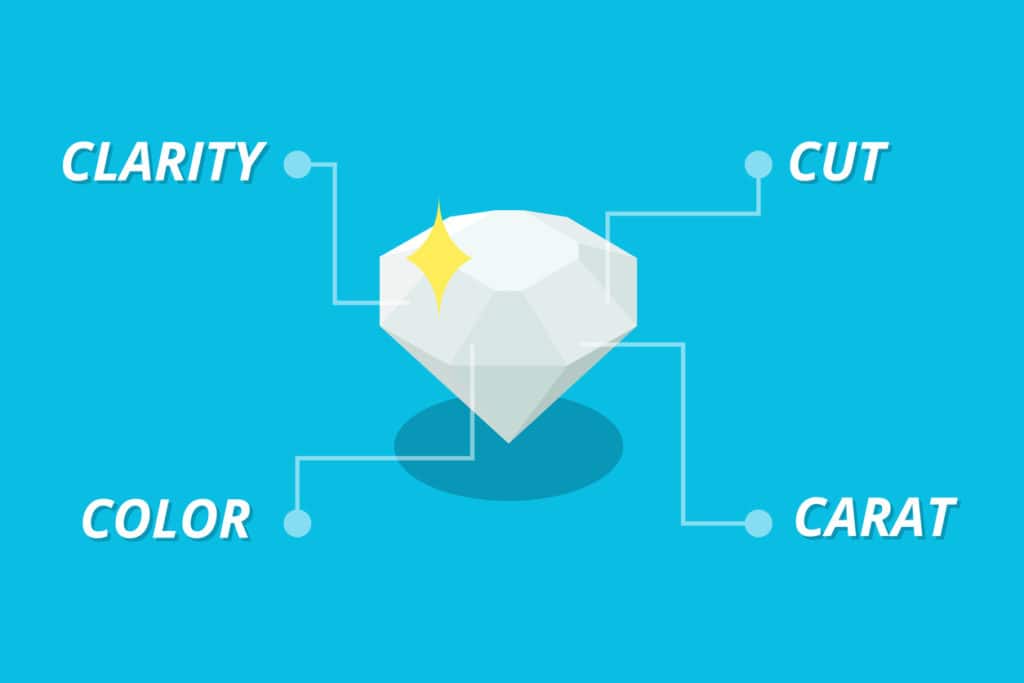
What are the 4 C’s?
Every diamond is evaluated using four characteristics, developed and standardized by the Gemological Institute of America. These are cut, color, clarity, and carat. Knowing them gives you a vocabulary that levels the playing field in any jewelry conversation.
Cut: The Most Important One
Cut is not the shape of the diamond. It refers to how precisely the stone was crafted to interact with light. A well-cut diamond takes the light that enters it and sends it back out as sparkle. A poorly cut diamond, regardless of its other qualities, will look dull and flat.
Every major gemological organization agrees: cut is the most important of the four. If you’re going to prioritize spending anywhere, it’s here. Look for grades labeled Excellent or Ideal.
Color: Where Most Guys Overspend
Diamond color is graded on a scale from D to Z. D is completely colorless and the most expensive. Z has a visible yellow tint. The practical reality is that a G or H grade appears colorless to the naked eye in virtually every setting. The difference between D and G requires trained eyes under lab conditions to detect.
Unless she has specifically asked for a colorless grade, anything in the G to H range gives you a stunning stone without paying for a distinction no one will see.
Clarity: Another Common Money Pit
Clarity measures the natural imperfections inside a diamond, called inclusions, as well as any surface blemishes. The scale runs from Flawless down to Included.
Gemologists use the term “eye-clean” to describe stones where no imperfections are visible without magnification. A VS2 or SI1 rating typically meets that standard, depending on the stone. You do not need Flawless. You’re paying for perfection under a loupe that will never be applied to her finger.
Carat: Size Isn’t Everything
Carat is simply the unit of weight, which roughly translates to physical size. Here’s a practical tip the industry rarely volunteers: pricing jumps significantly at round carat numbers. A 0.9-carat diamond looks nearly identical to a 1.0-carat, but the price can drop noticeably below that threshold. The same applies at 1.9 versus 2.0, and so on.
If budget matters, going just under a round number is one of the smartest moves you can make. Put that savings toward a better cut.
The short version: Prioritize cut above everything else. Get a good cut in G–H color and VS2–SI1 clarity, and put any remaining budget toward carat weight.
Shape vs. Cut: These Are Not the Same Thing
The terms “cut” and “shape” are used interchangeably by almost everyone who hasn’t bought a diamond before. They mean completely different things.
Shape is what you see when you look down at the ring: the outline of the diamond. Round, oval, emerald, pear, cushion, princess, marquise, radiant, etc. These are all shapes.
Cut is the quality of how that shape was crafted: the proportions, symmetry, and facet angles that determine how much light the stone reflects. You can have a round diamond with an excellent cut or a round diamond with a poor cut.
Shape is style; cut is quality.
The round brilliant is the most popular shape by a wide margin, accounting for about 62% of all engagement ring sales, according to the Natural Diamond Council’s 2025 report. It’s also the most researched and standardized in terms of grading. It tends to produce the most sparkle, and it’s the safest choice if you’re genuinely unsure what she wants.
Oval and other elongated shapes (pear, marquise) continue to be very popular because they can look larger than their actual carat weight suggests. The elongated silhouette flatters the finger and offers a lot of visual impact for the price. Marquise in particular is climbing fast: up 12% year-over-year, as women discover its distinctive look and finger-lengthening effect.
Emerald and asscher cuts are popular among people who want something more architectural and understated. These cuts don’t hide inclusions as well, so clarity matters more if you go this route.
One practical note on price: fancy shapes (anything non-round) typically cost up to 25% less than a round brilliant of the same quality, because they waste less rough diamond in the cutting process. A non-round shape isn’t a downgrade. For a lot of women right now, it’s the more desirable choice.
Ring Settings: The Hidden Decision
Most guys focus entirely on the diamond and treat the setting as an afterthought. That’s a mistake. The setting is the metal structure that holds the stone, and it has an enormous impact on how the ring looks, how it wears, and how much it sparkles.
The same diamond placed in two different settings can look like two completely different rings. Getting the setting right matters as much as getting the stone right.
A simple framework: ask three questions before you choose.
- How much sparkle does she want?
- How much protection does the stone need?
- And does she want the ring to look visually larger than the stone actually is?
Your answers point you directly to the right setting.
The solitaire is the most popular setting by a wide margin: roughly 40% of all engagement rings. One stone, held by prongs, center stage. It’s timeless, clean, and maximizes sparkle because the prongs allow maximum light into the diamond. The trade-off: prongs can loosen over time and should be checked by a jeweler every six to twelve months.
The halo surrounds the center stone with a ring of smaller diamonds. It’s the second most popular setting at around 15–18% of rings. A well-designed halo can make the center stone appear up to half a carat larger than it actually is. This is a genuinely smart choice if you want to maximize visual impact on a tighter budget.
The bezel setting wraps a metal rim completely around the diamond’s edge. It’s the most protective option, ideal for someone with an active lifestyle or a hands-on job, and has a sleek, modern look. The trade-off is that it blocks some light from the edges of the stone, slightly reducing brilliance.
Pave (pronounced “pah-VAY”) lines the band with tiny diamonds set flush into the metal, adding sparkle all the way around the ring. Beautiful, but it requires more regular cleaning and maintenance than a plain band over time.
The three-stone setting (one center stone flanked by two smaller stones) carries meaning beyond aesthetics. Traditionally it represents your past, present, and future together, which gives it lasting symbolic appeal.
One final note that applies to settings as much as it does to shapes: settings are deeply personal. Some women have had a specific one in mind for years. The goal isn’t to pick the most popular or most impressive option; it’s to pick the one that fits how she actually lives.
Band Metals: More Options Than You Think
Here’s something a lot of guys don’t realize: what most people call a “silver-colored” ring isn’t silver at all. Actual sterling silver tarnishes and is too soft for daily wear. No reputable jeweler uses it for engagement rings. What you’re actually choosing between is white gold, yellow gold, rose gold, or platinum.
Yellow gold is the classic. Warm, timeless, and as we cover in the trends section below, experiencing a significant resurgence.
White gold looks silver-toned, is more affordable than platinum, but has a rhodium coating that wears off over time. It’s recommended to be professionally replated every several years, typically around $75 per visit.
Rose gold is a gold and copper alloy with a warm, distinctive look that a lot of women love, particularly for its vintage feel
Platinum is the premium “silver-colored” option: naturally white, never needing replating, hypoallergenic, and significantly more durable than gold. It’s also the most expensive.
For most buyers, 14 karat gold in whatever color she prefers is the sweet spot: durable, beautiful, and the most widely used metal in engagement rings. 18 karat gold is softer and richer in color but scratches more easily with daily wear.
You may also encounter 24 karat gold, which is pure gold with no alloy. It has a deeper, richer color than 14 or 18 karat, but it’s significantly softer and bends and scratches with daily wear. It looks beautiful in certain contexts, but it’s not the right choice for a ring someone will wear every day.
The Easiest Shortcut: If you’re shopping alone and unsure which metal color to choose, the answer is almost always on her wrist and in her ears. Look at the jewelry she already wears every day. People are consistent. If everything she owns is gold-toned, don’t buy her a white gold ring. That’s the easiest call you’ll make in this entire process.
Non-Diamond Center Stones: What Are Your Options?
Most guys assume an engagement ring means a diamond. And most of the time they’re right. About 83% of engagement rings still feature a diamond center stone, according to The Knot’s 2025 Real Weddings Study. But that means roughly 1 in 6 don’t, and that number is growing. If she has any interest in something non-traditional, you need to know your options.
The most important thing to know about any non-diamond center stone is how it holds up to daily wear. Gemologists use the Mohs hardness scale to measure scratch resistance: diamond is a 10, the hardest material on earth. Any stone below 7–8 is generally not recommended for a ring worn every day, as it will show wear and damage over time.
Moissanite is the fastest-growing diamond alternative on the market. It’s lab-created, rates 9.25 on the Mohs scale (making it extremely durable), and costs a fraction of what a diamond does—around $900 per carat compared to $4,000 or more for a comparable natural diamond.
The honest aesthetic difference: moissanite produces more than twice the “fire” of a diamond (that rainbow-flash sparkle effect). Some women love it. Others find it too flashy compared to a diamond’s more subdued brilliance. Worth seeing both in person before deciding.
Sapphire is the other leading non-diamond choice. It rates 9 on the Mohs scale, completely suitable for daily wear, and comes in nearly every color, not just blue. Pink, white, yellow, teal, peach. For a woman who wants something with color and personality, a sapphire is a serious option with real durability, not a compromise.
Emeralds are stunning but require more caution. They typically rate 7.5–8 on the Mohs scale, but they’re prone to chipping because of their natural internal inclusions. If she has her heart set on an emerald, a protective bezel setting helps, but go in knowing it requires more careful handling than a diamond or sapphire.
Opals, pearls, and other soft stones are generally not practical as a center stone in a ring worn every single day, regardless of how beautiful they are. Reserve those for settings designed for occasional wear.
IMPORTANT: If she’s never mentioned wanting anything other than a diamond, assume she wants a diamond. Women who feel strongly about an alternative stone almost always make it known. This is not the moment for creative interpretation. The diamond is the safe, reliable default, and there’s nothing wrong with that.
Lan-Grown vs. Natural Diamond
This is the conversation that has genuinely transformed the engagement ring industry over the past several years, and in 2026, it’s no longer a niche debate. It’s a central decision every ring buyer needs to make.
What is a lab-grown diamond? Exactly what it sounds like: a real diamond grown in a controlled environment rather than mined from the earth. According to the GIA, the most respected diamond authority in the world, lab-grown diamonds are chemically, physically, and optically identical to mined diamonds. Even a trained jeweler cannot tell them apart with the naked eye. Specialized laboratory equipment is required to distinguish them.
What’s the price difference? Significant. Lab-grown diamonds now cost 70–80% less than comparable mined stones. A 1-carat lab-grown diamond averages around $1,000 or less in 2026, according to BriteCo’s 2025 diamond industry report. A comparable natural diamond runs around $4,200. That’s the difference between a 1-carat stone and a 2.5-carat stone for the same budget. Lab-grown diamond prices have fallen about 74% since 2020, driven by mass production and growing supply.
What’s the trade-off? The main concern with lab-grown diamonds is resale value. They have essentially none. Natural diamonds don’t hold their value particularly well either, but lab-grown diamonds have depreciated sharply as the market has grown. If you’re buying an engagement ring as an investment, you’re doing it wrong. But if resale value is a concern for practical reasons, natural diamonds do retain more.
There’s also a sentimental dimension. Some people feel strongly that a natural diamond, formed over billions of years under the earth, carries more meaning. Others find that story irrelevant or even problematic given the history of diamond mining.
The bottom line: Lab-grown diamonds make a lot of sense for buyers who prioritize the visual impact of the ring and want to maximize what their budget can achieve. Natural diamonds make sense for buyers who place value on the geological origin of the stone or are concerned about long-term resale. Both are real diamonds. Neither choice is wrong.
Where Should You Buy the Engagement Ring?
You have more options than ever, and the right answer depends on what kind of buyer you are.
Chain Jewelry Stores
Chain stores like Helzberg, Kay, and Jared are convenient, accessible, and a genuinely good starting point for anyone new to this process. You can walk in without an appointment, see a wide variety of styles in person, and get a feel for shapes, settings, and sizes before committing to anything.
Most chains also offer solid financing, strong return policies, and in-store services like resizing and cleaning that online retailers simply can’t match. If you find a ring at a chain store at a price you’ve verified is competitive, there’s nothing wrong with buying it there.
Two things worth knowing going in: chain stores carry significant overhead, including real estate, staffing, and inventory, and those costs factor into their pricing. It’s worth doing some price comparison on comparable certified stones before you commit. Additionally, most chain store salespeople are paid on commission, so they have a financial stake in what you buy. That’s not unique to jewelry, but it’s useful context. Go in knowing what you want, ask a lot of questions, and don’t let anyone rush the decision.
Local Independent Jewelers
An independent jeweler is often the most overlooked option, and frequently the best one. A good independent jeweler has built their entire business on expertise and word-of-mouth. They’re not working toward a corporate quota. Their incentive is to get you into the right ring, because their business depends on referrals and repeat customers.
Independent jewelers tend to offer more flexibility on pricing, deeper knowledge, and a much higher level of customization than chain stores can match. They can source specific stones, modify existing designs, and build something entirely custom. And if you find one you trust, they become a resource for life: cleanings, resizing, repairs, the wedding band, all of it.
The way to find a good one is simple: ask recently engaged friends and family for referrals. Check reviews carefully. When you visit, ask whether they work with GIA or IGI certified stones. Any reputable independent jeweler will say yes without hesitation.
Online Retailers
The hesitation most guys feel about buying a ring online is understandable. It’s a lot of money for something arriving via FedEx. But reputable online retailers have invested heavily in making this experience trustworthy: 360-degree HD & 4k video of every stone, complete grading documentation, access to real gemologists by chat or phone, and free return policies that give you time to evaluate the ring in person once it arrives.
The pricing advantage is real. Online retailers don’t carry the overhead of physical stores, and that difference tends to be reflected in what you pay. A smart approach is to browse in person first to understand what styles and sizes appeal to you, and then shop online with that knowledge. You’ll have a much clearer sense of what you’re looking at, and you’ll be making a more informed decision.
The bottom line: Whichever channel you choose, look for GIA certificates on natural diamonds and IGI certificates on lab-grown stones, a clear return and resize policy, and pricing transparency with no pressure to buy on the spot. According to The Knot’s 2024 study, the average buyer visited five different jewelers before purchasing. Take your time.
Custom vs. Ready-Made: Understanding the Spectrum
Ring shopping isn’t a binary choice between picking something off a shelf and commissioning a fully custom piece. There’s a spectrum, and understanding where you fall on it helps you make a better decision for your timeline and budget.
Ready-Made
Ready-made rings are in stock and available immediately. You walk in, you find one you love, you walk out. Or you order online and it ships within a week or two. This is the fastest and most straightforward path.
Semi-Custom
Semi-custom is where most buyers actually land, even if they don’t realize it. You start with an existing design and modify it: a different center stone, a different metal, an engraving inside the band, a slight variation in the setting style. According to The Knot’s 2025 study of over 10,000 recently married couples, nearly 90% of buyers made at least some customization to their ring. It’s the norm, not the exception.
Fully Custom
Fully custom means designing from scratch with a jeweler. You choose everything. This is the right path when she has a very specific vision that existing designs can’t capture, or when you want to incorporate something meaningful, like a family heirloom stone.
The Timeline Factor
This is the part that catches people by surprise. A fully custom ring typically takes four to eight weeks from the first consultation to delivery, and that’s for a relatively straightforward design. Complex work from a high-end independent jeweler can take three to four months.
If you have a specific proposal date in mind, build your timeline around it and add a buffer. And even for ready-made rings, don’t cut it close. Resizing takes one to two weeks at most jewelers. Online orders need shipping time. Walking in the week before a planned proposal is how things go wrong.
Should You Go Engagement Ring Shopping Together?
The short answer: probably yes, and fewer people feel weird about it than you might think.
According to The Knot’s 2024 Jewelry and Engagement Study, which surveyed over 7,000 recently engaged couples, 77% of women had some involvement in their ring selection. Only 23% said it was a complete surprise. A 2024 Jewelers Mutual study found that 46% of couples shopped for the ring together outright. The era of the full-surprise ring is becoming the exception, not the rule.
The idea of a surprise proposal with a mystery ring is still romantic to many people, but it’s also high-risk. Engagement rings are intensely personal. The difference between a ring she loves and a ring she tolerates wearing every day is significant. Going together doesn’t have to spoil the surprise of the proposal itself.
Many couples now treat ring shopping as a shared process while keeping the actual proposal moment a surprise. You shop together, narrow it down, make the purchase, and she still doesn’t know when or how you’re going to pop the question. As James Allen gemologist Lorraine Brantner puts it: “you can shop together on the design and keep the timing of the purchase and the proposal itself a complete surprise.”
The ring doesn’t have to be the surprise. The moment can be.
If you’re committed to complete surprise, the next best move is doing serious intelligence work: looking through her Pinterest boards, asking her close friends or sister, paying attention to what she gravitates toward when you’re around jewelry in any context. Then buy something that reflects what she actually likes, not what you think looks impressive.
Which Approach Is Right for Your Relationship?
Think about who she is. Does she have strong opinions about most things in her life and would feel anxious not being involved in a decision this significant? Involve her. Does she love being swept off her feet and trusts you completely to make a meaningful choice? Go solo and do your homework.
There’s no universal correct answer. There’s only the right answer for your specific relationship, and you probably already know what it is.
Either way, one thing to consider: if you’re unsure of her exact ring size, proposing with a placeholder band or a slightly oversized ring is far better than a ring that doesn’t fit. Most jewelers resize for free.
How to Find Her Ring Size Without Ruining the Surprise
If you’re going the surprise route, ring size is one of the most practical problems you’ll face. Here are the most reliable approaches:
Ask someone in her inner circle. A close friend, her sister, or her mom may already know, or can find out without raising suspicion. Just make sure whoever you ask can actually keep a secret. The more people who know, the faster it leaks.
Borrow a ring she already wears. If she has a ring that fits her left ring finger, take it to a jeweler and have it measured. If she only wears rings on other fingers, those sizes won’t be accurate since every finger is different, but it gives you a starting point.
Trace it. If you can’t take the ring out of the house, trace the inside of it on paper and bring that to a jeweler. They can match the diameter to a size.
Size up if you’re guessing. Most rings can be resized, and it’s easier to size down than up. If you’re working from a rough estimate, go slightly larger. A ring that’s too big is a quick fix. A ring that won’t go past her knuckle is a much bigger problem.
Resizing typically takes one to two weeks and costs $20–$150 depending on the metal and complexity. Note that very thin bands and rings covered edge-to-edge in stones (eternity bands, tension settings) can be difficult or impossible to resize, so ask about this before you buy.
When in doubt, go together. There’s no shame in shopping together and skipping the ring size guessing game entirely. As covered above, you can still make the proposal itself a complete surprise.
Ring Trends in 2026: Trendy vs. Timeless
Knowing what’s trending is useful, but knowing the difference between a trend and a lasting style is more important when you’re buying something she’ll wear for decades.
What’s trending right now:
Oval and elongated shapes continue their multi-year run. They’re everywhere, and for good reason: they photograph beautifully and wear elegantly. That said, oval in particular is beginning to show its first signs of saturation. Some women are already looking for something with more visual distinction.
Marquise is having a significant moment, up 12% year-over-year, driven by the same finger-lengthening appeal that made oval popular, with a more distinctive silhouette.
Emerald cut is growing fast (up 7% year-over-year), driven by women who want something architectural and understated rather than maximum sparkle.
East-west settings, where the stone is set horizontally across the band rather than vertically, have picked up steam as a modern alternative to traditional solitaires.
Colored stones (sapphires, morganites, emeralds) are increasingly popular, especially among buyers who want something distinctive or who aren’t attached to the diamond tradition.
Cluster and multi-stone rings are having a moment, particularly as alternatives that maximize visual impact at a lower price point than a single large stone.
Minimalist and stackable bands appeal to buyers who want something understated that can evolve over time.
Yellow gold is back in a big way after years of white gold and platinum dominance. According to The Knot’s 2024 study, yellow gold went from appearing in just 9% of engagement rings in 2017 to 36% in 2024, nearly a fourfold increase in seven years. It’s now as popular as white gold, and still climbing.
The broader shift: personalization. Vintage-inspired details, antique cuts, hidden halos, bezel settings, rings that look like they could have been passed down. The era of the generic solitaire as the default is fading. People want something that tells a story.
What’s actually timeless:
The round brilliant solitaire. It has been the most popular engagement ring style for decades and will continue to be. Clean, classic, and universally flattering.
A simple pavé or cathedral setting in white gold or platinum. Nothing here will feel dated in 20 years.
Three-stone rings (representing past, present, and future). The symbolism gives this style staying power.
A quality halo setting around a round or cushion center stone. Adds sparkle and visual size without being trendy.
The rule of thumb: If she’s someone who loves fashion and embraces what’s current, trending styles are a reasonable choice and she’ll likely evolve the ring over time anyway. If she’s more classic in her tastes, stick to the timeless options. She’ll still love it in 30 years.
Should You Think About the Wedding Band Now?
The short answer is yes, at least a little. You don’t need to buy the wedding band when you buy the engagement ring, but it’s worth thinking about how the two will eventually sit together on her finger.
Engagement rings and wedding bands are worn stacked. After the wedding, most people wear both rings on the same finger. If the engagement ring has an unusual shape, an elevated setting, or a curved profile, a standard straight band may not sit flush against it. Some engagement rings are designed with a contoured or notched base specifically to accommodate a matching band. If you’re buying a more architecturally complex ring, ask the jeweler whether a coordinating band is available or recommended.
Buying as a set is an option, not a requirement. Bridal sets (engagement ring and wedding band sold together) ensure a perfect match in metal, style, and fit. They can also come at a slight discount compared to buying separately. That said, many couples prefer to choose the wedding band later, together, once the engagement is official and the initial excitement has settled. Neither approach is wrong.
Metal matching matters more than style matching. If the engagement ring is yellow gold, a white gold or platinum wedding band stacked next to it will look mismatched. Try to at least keep the metal consistent, even if the styles differ. Mixed metal settings (like a yellow gold band with white gold prongs) can make this trickier, so ask your jeweler what they recommend for a future band pairing.
You don’t need to have it figured out now. Buy the engagement ring that’s right for her. When the time comes to choose the wedding band, you’ll have a lot more information, including her input, to work with.
How Much Time Do You Actually Need?
This is one of the most overlooked parts of ring shopping, and it matters a lot if you have a proposal date in mind.
If you’re buying a ready-made ring from an online retailer, you can typically place an order and receive it within one to two weeks, sometimes faster with expedited shipping. This is the fastest path.
If you’re buying from a physical store, plan for at least two to four weeks. Even if the ring is in stock, you may need to wait for sizing, setting adjustments, or engraving.
If the ring needs to be ordered or made to spec, timelines vary widely. A ring that needs to be ordered from a vendor rather than pulled from existing inventory can take three to six weeks. Custom work from a designer or independent jeweler can take six to twelve weeks or more depending on complexity and their current workload.
Lab-grown diamonds are generally faster to source than natural diamonds of a specific spec, since supply is less constrained. If you need a specific stone quickly, lab-grown gives you more options.
Resizing adds time. If the ring doesn’t fit perfectly when it arrives, factor in another one to two weeks for resizing, depending on the jeweler.
The practical takeaway: if you have a specific proposal date, work backward from it and add two weeks of buffer. If you’re proposing on a holiday, anniversary, or trip that can’t move, start shopping six to eight weeks out to be safe. Rushing this purchase is how mistakes happen.
The Grading Report: What It Is and Why You Always Need One
Any diamond worth buying should come with a grading report from an independent gemological laboratory. Not a certificate from the store. Not the jeweler’s own appraisal. An independent, third-party lab report. If a jeweler can’t produce one, walk out.
A grading report is essentially a diamond’s passport. It’s a document issued by an independent lab that verifies the stone’s cut, color, clarity, and carat weight (the 4 Cs) without any commercial interest in the sale. It also confirms whether the diamond is natural or lab-grown, and includes a unique report number that’s laser-inscribed on the diamond itself. That number lets you verify that the stone you’re holding matches the document in your hand.
Two labs you need to know:
GIA (Gemological Institute of America) is the gold standard for natural diamonds. The oldest, most respected, and most consistent grading authority in the world. Every reputable natural diamond of significant value should have a GIA report.
IGI (International Gemological Institute) is the most widely used and accepted lab for lab-grown diamonds. It’s what most reputable retailers use for their lab-grown inventory, and it’s the cleaner option for lab-grown since GIA changed its grading system for lab-grown stones in October 2025 and no longer uses the traditional D-Z color scale for them.
Two things to watch out for:
In-house certificates issued by the retailer themselves. These are not the same as an independent lab report. They’re self-issued, unverifiable, and carry no weight outside the store that produced them.
EGL (European Gemological Laboratory) certificates. EGL has a well-documented industry reputation for grading more generously than GIA or IGI, meaning you may be paying for quality grades the stone doesn’t hold up to under stricter scrutiny.
The simple rule: GIA for natural diamonds. IGI for lab-grown. Independent lab only—never in-house. Without a grading report, you also typically cannot insure the ring.
Do You Need Engagement Ring Insurance?
You just spent thousands of dollars on an engagement ring. Here’s something almost nobody thinks about until it’s too late: nearly half of all engagement rings are uninsured.
Most standard homeowners and renters insurance policies cap jewelry coverage at $1,500 to $2,500, and that’s for theft only. Drop the ring down a drain, lose it at the beach, chip the stone—a standard policy doesn’t cover any of that. According to a Jewelers Mutual survey, half of ring owners said they couldn’t afford to replace their ring if something happened to it. That’s a significant exposure for something you’re carrying around every day.
A standalone jewelry insurance policy covers loss, theft, accidental damage, and what insurers call “mysterious disappearance,” meaning it simply went missing and you don’t know exactly how. It covers the ring at its full appraised value, anywhere in the world. The cost is typically 1–2% of the ring’s value per year. On a $5,000 ring, that’s $50–$100 a year.
Jewelers Mutual is the most well-known specialty jewelry insurer. Your existing home or renters insurance provider may also offer a jewelry rider as an add-on, which is worth comparing. Just make sure to get the full details so you know exactly what’s covered.
Don’t wait until after the proposal. Get coverage as soon as the ring is in your possession. You also typically need the grading report (discussed above) to get the ring insured at full value, another reason those two things go hand in hand.
A Few Final Things Worth Knowing
Ask about the return policy. Things happen. Tastes change. Sizes are wrong. Before you buy, understand exactly what your options are if you need to return or exchange.
Don’t rush. Unless you have a proposal date locked in, take the time to do this right. Two weeks of research will save you from years of regret (or at minimum, a very uncomfortable return conversation).
The ring is a beginning, not a finish line. Once you’ve made the right choice, let it go. The proposal, the marriage, the life you’re building together are the actual things. The ring is just a very good opening move.
Ready to take care of your guys?
Once the ring is on her finger, the next step is making sure the men who helped you get there feel as appreciated as they deserve.
The Man Registry has personalized groomsmen gifts for every type of guy in your group. Unique gifts they’ll actually use, ranging from travel bags, coolers, barware, hunting gear, and more. Shop now!